Monday, August 26, 2013

Three Things You May Not Know About Social Media Marketing at Aurora University

Social Media Marketing Can Be Taught


First, you may not know that we teach Social Media Marketing at Aurora University.  The Social Media Marketing course I am teaching is new this semester.   I recently accepted a position as Full Professor of Marketing at AU and will be teaching in the Marketing Department.  Next Fall we are launching a new Digital Marketing Undergraduate Minor.  However, you can take Social Media Marketing as part of the current Undergraduate program in Interactive Marketing, earning either a minor or a concentration. 

I have been teaching Internet Marketing for almost fifteen years and many former students are working in social media. This area of marketing has strong employment potential, something I am always aware of when deciding what material to cover in class.  You can read more about my background and teaching philosophy and find how where to find me on social media here.


Social Media Marketing


Social Media Marketing Has Many Sides


Everyone reading this post may be familiar with and able to post to one of the major Social Media Platforms like LinkedIn and Twitter.  We are going to learn how to create a personal social media plan, including a LinkedIn profile that will get you noticed in searches.  In the course of this plan we will learn the major social media platforms and how to use them to get noticed by potential employers and others in the field.  Along the way we will learn about Google Authorship, effective blogging techniques and how to write for social media.

We will also learn the structure and discipline of a corporate social media plan and how it fits into a digital marketing strategy.  In every marketing discipline we need to learn how to plan, implement and measure our programs.  Social Media Marketing is no different.  As I have previously stated in this blog and on slideshare, I view social media as integral to content marketing.  In fact content marketing 'makes sense' of the seemingly disparate forms of social media depicted by the above graphic.

Your work products from this class will be both the Personal Social Media Plan as well as a corporate plan.  In addition, you will know how to build a presence on LinkedIn, Twitter, Facebook, Pinterest, Instagram, Google+ and YouTube.  The course has lots of lab time and is interactive and collaborative.  You won't be bored---I hope!

You Can Still Enroll


If what you read is interesting to you, there are still spots left in Social Media Marketing.  
BUS 4610 01 Social Media Marketing meets Tuesday & Thursday  1:15 pm to 2:30 pm, DH 102. I hope to see you there.  For those who can't fit the course into their schedule and for my corporate friends  follow the progress of the course in this blog.

By Debra Zahay-Blatz.
You can find Debra on  and Twitter as well as LinkedIn.

Monday, August 5, 2013

Interactive Marketing Graduate Tells All: Search Guru Mike Glassberg

Comments from Recent Grad Mike Glassberg:

"Who am I?
Hey everyone! My name is Mike Glassberg, I’m a proud graduate of NIU’s (outstanding!) Interactive Marketing program put together by Dr. Zahay-Blatz. I recently started an internship at Modern Marketing Partners where I provide SEO and social media services to clients.


Mike Glassberg, Debra Zahay-Blatz, SEO, social media
Practicing What They Preach: Glassberg and Zahay-Blatz
 at networking event at Modern Marketing Partners
 in Naperville earlier this Summer.


How did the Interactive Program help me in my current job?

Wow – not until I talked to my colleagues at MMP (who have all graduated within the last few years) did I realize how superior our program was. To start, most other schools still don’t offer specialized education in “interactive” or 2-way marketing.

Our class did a paid search campaign using Google Adwords with real companies, a search and social campaign, and since day on on the job, I’ve been able to speak the lingo: Alt tags, Bounce rate, stickiness, etc. One of the things that really helped in my current job is learning the Wordpress and Google+ ecosystem. As an SEO consultant, it is my job to be able to optimize a website for tags, and the hands-on experience I had as a student was invaluable going into my current position.

What about some advice for current students?

Don’t limit yourself to the jobs at career fairs. I saw so many students get down on themselves because they didn’t get an internship or job offer at the bi-annual NIU career fairs. The opportunities for employment outside of NIU are virtually limitless.

The only reason I received my job is because I went to a networking event with Dr. Zahay-Blatz. My boss wasn’t actively looking for an employee, but after a brief conversation, he (presumably) saw something he liked and went with his gut feeling.

What are three ways to find an awesome job outside of NIU’s career fairs?

1.) Networking – Dr. Zahay-Blatz has a number of events per semester that she invites students to. Step out of your comfort zone and go to one. You’ll meet industry professionals, learn an incredibly amount, and start building your network.
2.) LinkedIn – The 2nd best way to find a job is through LinkedIn, but only if you’ve done step 1 first. The more meaningful connections you have, the more likely you are to find someone, who knows someone, who can land you an interview.
3.) Huskies Get HiredThis was consistently one of the most underutilized resources when I was a student. There’s a job board online with employers actively looking for students that go to NIU. Take advantage of that while you can.
Thank you for reading; I hope this post provided you with some insight. If you have any questions for me, feel free to reach out anytime, I’m pretty quick at responding through any medium." 

You can follow +Mike Glassberg on G+ or Twitter at @mglassberg2.  I wasn't surprised he has done so well right after graduation as he was active in networking, LinkedIn and Huskies Get Hired.  Most jobs are not advertised so networking is key.

By Debra Zahay-Blatz.
You can find Debra on  and Twitter as well as LinkedIn.

Saturday, July 13, 2013

How to Tell Your Story through Content Marketing and Still Have a Life

Content Marketing Makes Social Media make Sense

At my talk at Kishwaukee College yesterday I reiterated my theme from a prior blog post on content marketing that content marketing makes social media make sense.  I defined content marketing and content creation, explained the role of strategy in the process and then went on to give some examples of how to re-purpose content to get the kind of growth that we need.

What is Content Marketing?

Content marketing is a series of steps and processes as related to the media owned by a company, whereby that media is used to attract and retain customers.  We often speak of content 'curation,' which indicates that content is developed and managed 'by hand,' instead of spun by machines or just regurgitated in another format.  Content should be carefully prepared to reinforce the company 'story' or brand image.


Steps for Content Marketing

The process for good content marketing is as follows:
1) Start with a brand story.
2) Figure out meaningful message and associated content related to that story.
3) Dissseminate that content where your audience is likely to be so they can consume the content, react to it and co-create content.

Self-Knowledge is the Key

Understanding your company strategy and why you are creating the content is a useful exercise in content creation marketing, and, as I explained in a prior blog post, the first step in content marketing.  The company strategy can be translated into the story for the brand using the simple format for a positioning statement that I use in class.

The format is to the Target Customer, the Product Name is the Product Category that Point of Difference.  For example, Colgate's WISP product for brushing your teeth on the go might have used this format for the positioning statement.

"To the on-the-go college student or urban professional, ages 18 to 25, both male and female, WISP is the mini-disposable toothbrush that makes you Be More Kissable."  The company target is Generation Y and the idea is that if your teeth are fresh, no matter how busy you are,  you will be more attractive to the opposite sex.  This simple positioning statement then provided the brand story, which lead to an active social media campaign.  The company chose various forms of social media, including some clever YouTube videos, to convey its message because that is where its audience resides.

My Story as an Example

I gave the example that as a marketing professor I wanted to reach marketers who would view our program as a thought leader and potentially hire our students.  With that in mind, my social media journey really began with LinkedIn, since that is a social media site devoted to business leaders.  I now have over 2,000 connections on LinkedIn and am in the top 1% of those on the system.

At the same time I posted on LinkedIn, I also worked to increase my Twitter following, within a targeted group.  However, things did not really take off for me in terms of social media until I started posting meaningful content on a daily basis.  Like many professionals, I have a job other than creating content for social media (teaching, research, service), so I rely on disseminating the content of others as well.

I try to blog weekly and invariably the most comments I get are on the content I create myself.  So one strategy is to add value to re-posted content, not just send it out again in a different form, but really provide another aspect of the content and insight from what is written.  I pose a question or interpretation or comment when I re-post the comments of others, thereby making the content part of the stream of content people see on a regular basis.

I also make the most of my own content by thoughtful re-purposing.  For example, I recently gave a talk at Conversion Conference with Brian Massey on how direct marketing lessons can be used in website conversion.  We took that material and made a Slideshare with audio and then I referred to that material on my own blog, giving a recap of direct marketing principles as used for paid search.  I am also a guest blogger for Exact Target and I was able to create a blog post for them on the psychological background behind our talk, still linking back to that original blog post.

So now with the same talk as a basis, I created three different perspectives on the material, all of which contributed to a spike in pageviews for my blog.  When I started posting meaningful content five times a week, I went from 400 pageviews per month to almost 5,000.

Remember, your customer will respond to a good story and good content to tell that story.  If you want to see the slides from my talk on this subject, you can access the Slideshare above.  Let me know if you have any questions.

By Debra Zahay-Blatz.
You can find Debra on  and Twitter as well as LinkedIn.

Saturday, June 22, 2013

How Secrets of the Past Can Optimize Conversion Today


At  Conversion Conference in Chicago, +Brian Massey (the Conversion Scientist) and I (the Professor) gave a talk on how CRO (Conversion Rate Optimization) principles really had their roots in Direct Marketing Response Principles.  We talked about the discipline of conversion’s roots in direct marketing and how these principles have been used in traditional direct mail and can be applied to the web. We Introduced some of the names in the direct marketing and advertising field that you may not know and to shared some of their wisdom.

Our talk was called, “Everything I Needed to Know about CRO I Learned from Direct Marketing,” based on these principles.  We talked about their roots in direct marketing and how these principles have been used in traditional direct mail and can be applied to the web.  We hailed back to David Ogilvy, Jim Kobs and Murray Rafael, who applied persuasive principles in the testing environment of direct marketing. 

Using Direct Marketing Principles for Paid Search

I noted results  some classroom examples from paid search campaigns.  For example, just by adding to word “free” to an offer, using the principle of reciprocity (buy something and who will get something back from me for ‘free’) dramatically increased results in a paid search ad.  Using the scarcity principle “act now while supplies last” also dramatically improved click through rates, which was our conversion measure.  If you missed our talk, catch the slides and the audio on Slideshare.

Why and How Direct Response Principles Work on the Web

Brian explained how the human brain works and how we need to get past the area in the brain that automatically filters out messages.  Human beings respond to persuasive principles because the brain is ‘hard-wired’ to recognize certain types of communications and respond to them.  Brian presented some excellent examples of online marketing that uses direct marketing principles.  One of these principles is long form copy.  Long form copy is based on the principle of commitment or escalating involvement.  As the prospect or customer reads first an offer, then information in other forms, he or she becomes more committed to our product.  The self-programming thermostat, The Nest uses these direct response techniques online.  Even though we hear that people don’t read or want to read on the web, if information is presented the right way, consumers will respond.

Remember the Customer

We also talked about how response really depends on the customer and where they are in the purchase process or in awareness of your product.  .Years ago advertising legend Eugene Swartz suggested “Five Levels of Awareness” and that we need to tailor our messages to customer awareness levels.  If the prospect is aware of our product, then discounts and deals are most effective.  If unaware, then stories and secrets help to build awareness.  We showed examples of different web sites and offers that were targeted to different levels of awareness.  We also stressed the importance of testing, so easy to do with today’s technology.

Thanks to +Tim Ash and +Casey Murphy for a great conference and for allowing us the chance to speak.

P. S.  Reminder:   If you missed our talk, catch the slides and the audio on Slideshare.

By Debra Zahay-Blatz.
You can find Debra on  and Twitter as well as LinkedIn.

Saturday, June 8, 2013

Everything I Learned about CRO I Learned from Direct Response Marketing


Direct Response Roots of Conversion Rate Optimization Revealed


Next week at the Conversion Conference in Chicago, +Brian Massey  and I will give a talk on how CRO (Conversion Rate Optimization) principles really had their roots in Direct Marketing Response.  We will talk about the discipline of conversion’s roots in direct marketing and how these principles have been used in traditional direct mail and can be applied to the web. We plan to introduce you to some of the names in the direct marketing and advertising field that you may not know and to share some of their wisdom. I use this wisdom in my classes and will share some of my examples of how to apply these techniques effectively.

This semester my students were creating paid search ads for real companies.  Usually about halfway through the exercise, they would say to me, “We have the right keywords and lots of impressions, why aren’t we getting any clicks?”  The answer of course is that the ads were not well-written, not compelling and did not encourage response. 

Just by adding to word “free” to an offer, using the principle of reciprocity, dramatically increased results.  Using the scarcity principle “act now while supplies last” also dramatically improved click through rates, which was our conversion measure.  So if you want to see and hear more examples and words from the wisest in direct response, come hear our talk on Tuesday at 10:30 am at the +Hyatt Regency McCormick Place.

By Debra Zahay-Blatz.
You can find Debra on  and Twitter as well as LinkedIn.

Monday, June 3, 2013

Act Now Before All the May Grads are Taken!


May Interactive Grads Doing Well in the Marketplace 


This is the happy time of year when my students are reporting daily that they are accepting jobs and internships with interactive agencies and client companies.  +Rebecca Mensing  is going to work at Resolution Media and both +Taylor Staus  and +Brittany Sarkisian were accepted into the Dotomi management rotation program.Thanks to board member +Neil Brown for hiring former IMB student board President +Mike Glassberg for an internship.

Post Your Job on Huskies Get Hired

Sorry there is not time to mention everyone.  If you are still looking for an intern-to-hire or a full time grad versed in social media, SEO and SEM, and other aspects of direct and digital marketing, check out the Interactive Marketing Portfolio on the NIU Huskies Get Hired web site.  You can post your jobs there as well.  Since the semester has ended, this is the best way to reach out to recent graduates and the close to 300 program graduates we have.

Spotlight on Kevin Simon: Interactive Generalist with Psychology Minor

One student still seeking a job with the best fit is this week's guest blogger, +Kevin Simon .  Kevin writes that he just received "a Bachelor of Science degree in Marketing, a certificate in interactive marketing and a minor in psychology from Northern Illinois University. I was accepted in the Marketing Honor Society last semester which was a great honor.

In addition to my academic studies, I have been a member of the Sigma Nu Fraternity for four years. I have held three positions within the fraternity, one on the Executive Board for the past two years.  These leadership roles allow me to communicate with other members on a daily basis and improve my charisma and delegating abilities. I held the alumni relations chair position for two years maintaining a database of almost 500 alumni, designing and editing semi-annual newsletters, and updating our website.

I also just stepped down as the treasurer of the Circle K International community service organization which has allowed me to learn money management skills as well as earn over fifty hours in community service not including opportunities with the fraternity. I have also had many opportunities to work with other groups on campus including the Campus Activities Board, Financial Management Society, as well as many intramural sports.  These diverse and well rounded roles have helped me develop excellent communication and teamwork skills."  

Kevin is seeking a full-time position in the interactive marketing field after graduating. His Interactive Marketing classes have helped targeting specific areas he finds most interesting.  He would like to find a generalist position in interactive marketing where he could use his psychology minor and his leadership and planning skills.  Good fits would be online marketing research, social media management, website usability and testing.

By Debra Zahay-Blatz.
You can find Debra on  and Twitter as well as LinkedIn.

Tuesday, May 28, 2013

Yes, We DO Teach Database Marketing at the Undergraduate Level


If you have heard of "Big Data" you may be interested in taking Database Marketing or hiring some of our grads for your company. "Big Data" technically refers to databases that are so large they can't be analyzed using standard statistical techniques.  However, all companies today are benefiting from data analysis and Database Marketing can help you understand how this is done and build the foundation for an entry-level job in the industry.  Together with Google Analytics from Marketing 470, students graduation from the IM program have a sound foundation in data analytics.

This video describes what we do in Database Marketing 455 at Northern Illinois University.  Students work with real-life company data that has been cleansed for teaching purposes.  They use basic statistical techniques in IBM SPSS such as t-tests, cross-tabs and regression to analyze a company's internal customer information, augmented with outside data and predict who the best customers will be and what will most likely make them profitable.  We them move on to segmentation techniques and  logistics regression to predict response.  Finally we look at some non-statistical data mining techniques such as CHAID and Neural Networking using IBM SPSS Modeler.  We compare three different predictive response models and analyze lifts, gains, and profitability.

Thanks to +Nicole Gault and +Mike Glassberg for putting this information together.

Congratulations to them both and to all our Spring 2013 Interactive Marketing graduates!

By Debra Zahay-Blatz.
You can find Debra on  and Twitter as well as LinkedIn.

Monday, May 6, 2013

How to Have Fun While Learning Marketing Technology


This video describes what we do in Marketing Technology 470 at Northern Illinois University.  It is the advanced course in our sequence, the 'capstone.' Students plan, implement and measure a paid search campaign using Google AdWords and Analytics and also developed a personal social media campaign. This semester we also did a a corporate social media marketing plan for the companies we have been working with all semester.  These firms are Ideosity and AllWorld.  Thanks to +Nicole Gault and +Mike Glassberg for putting this information together.

Congratulations to them both and to all our Spring 2013 Interactive Marketing graduates!

By Debra Zahay-Blatz.
You can find Debra on and Twitter as well as LinkedIn.

Everything I Learned About Social Media I Learned from My Students


This post shows how you can develop your brand, connect and contribute on social media networks and in a short time change how you are perceived and create value online.  We just finished our social media module in Marketing Technology at Northern Illinois University   I gave them a basic structure to start building a personal social media plan using the top five platforms of LinkedIn, Facebook, Twitter, G+ and Pinterest.  There was no time to have them develop videos but we discussed the importance of YouTube and video in general in improving search engine results and web site engagement.

Teaching this class is like teaching in a Petri dish, a big sloppy experiment in various aspects of digital marketing.  I can observe the results of marketing campaigns that we deploy, see which PPC approaches work best and how online and offline strategies interact.  In this case, I made some simple suggestions for each of the five social media platforms and then sat back and watch the results come back.  I already noted in a prior blog post that making simple profile changes to LinkedIn resulted in more targeted job opportunities within twenty-four hours.

What I noticed was that my students were able to get results quite quickly from simple changes that they made to their approach to social media.   When we started the project, few of them had an organized approach to their personal social media plan.   I just finished reading their reflection papers on the subject and want to share some insights as to what worked for them and can work for you.

You can change how you are perceived online

Just by following my advice and fleshing out their Google+ profiles, when they were logged in to Gmail they could see a more professional appearance online.  Their LinkedIn, blogs and other online information showed up first in search results and helped them to present a more professional appearance.  This all happened in a few weeks time and many of them had online profile to begin with that reflected their personal rather that their professional lives.  Social media marketing helped them develop their personal brand image.

You can connect to just about anyone

The students were asked to connect to people where they might want to find a job or just find out more about the interactive marketing field  and this approach was effective.  Students were able to find people at key interactive companies and connect to them.  I recommended having some sort of relationship before connecting, i.e., having met them at a seminar or participated in a group discussion or webinar with them, before making the connection.  The students have the added advantage of being students.  Everyone loves to help students (I know I do).  I told them make these connections now while they are in the student role.

Everyone can contribute something online

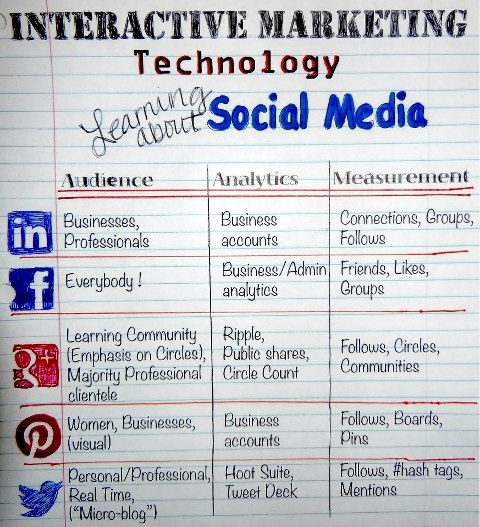
Sometimes students think because they are students they can't contribute.  They don't realize being in an Interactive Marketing program like ours gives them and advantage in terms of knowledge and understanding in the area.  But everyone has something to contribute online.  The students learned that they could take a blog post or something we had learned in class, put a twist on it or make a comment and create value for those reading the information.  Witness the graphical approach to taking notes in class above by +Felicia Aguillon.  Her summary of our last day of class on social media was well-received not just by me but other social media outlets where it was posted.

So this post shows you can develop your brand, connect and contribute on social media networks and in a short time change how you are perceived and create value online.  It only took a few weeks to change perceptions.  The students changed how they were perceived online and also how they were perceived by others.

By Debra Zahay-Blatz.
You can find Debra on and Twitter as well as LinkedIn.

Monday, April 29, 2013

Google Authorship Made Easy


Establishing Google Authorship Can Be Easy

This post summarizes how to create Google Authorship on your blog posts and other content.  There has been a lot of talk about Google Authorship and I have read some excellent posts about how to be credited in search results on Google.  I have shown an example above of how my blog shows up on Google when I am logged in to Gmail in the above screen shot.  I am shown with my picture, my name as shown on my G+ profile and the number of my G+ Circles.  This type of display is the goal. +Andy Crestodina  helped me establish this authorship in search   I followed the instructions that he presented at the January Chicago AMA Meet the Experts Night.  It took a few weeks but everything is showing up in search quite nicely now.  Even in my econsultancy.com blog authorship shows up after I followed these steps.

I think the key is to understand that there is a way to do this even if you are not blogging on a domain where you have an email on that same domain.  In my classes we use publicly available tools like WordPress or Blogger so we needed a way to link authorship without the verifiable email address.

Briefly, you need the following:
1) Put a nice head shot on your  G+ Profile
2) Use the same name on your profile as your byline, i.e.,  "By Debra Zahay-Blatz"
3) Copy and past HTML code into your blog that establishes the link.  Some code is on my slideshare presentation on this subject and on Andy's blog.

I also think it is important to set up your G+ profile properly with links to everything to which you contribute so these items can all show up in search as well.  Good luck establishing authorship and don't hesitate to contact me if you have any questions.  My slideshare presentation also shows how to link Google Analytics to your blog, which is extremely helpful in tracking activity and seeing information who you are reaching and how long they stay on the page.  

The slideshare also covers assessing your online presence, Filling out your Google+ Profile, Pursuisng Authorship and how to link your blog to Google Analytics.  The byline from the code is shown below.

By Debra Zahay-Blatz.
You can find Debra on and Twitter as well as LinkedIn.