Showing posts with label social media marketing. Show all posts

Saturday, May 3, 2014

Three Key Findings from Recent Research in Social Media Marketing

This spring at the +Marketing Management Association Conference March 26-28 at the Palmer House Hilton,  The conference featured several sessions on social media marketing.  Researchers looked at a social media networks and social media marketing's influence on brand equity, compared usage of social media sites by large brands and explored how particular brands appeal to their female customers on social media. This post explores the highlights from each presentation.


Attitude toward Social Networking Pages are Related to Brand Equity


The first presentation at the Friday 9:30 am session was titled, “Exploring the Impact of Social Networking Sites on Brand Equity.  The presentation was made  by researchers +Tiffany Machado Blanchflower and Kittchai Watchravesringkan from the University of North Carolina-Greensboro.  Not surprisingly, using the hierarchy of effects models and studying brand relationships across firms on Facebook, the researchers demonstrated that (just as attitude toward the brand influences brand equity) attitude toward the brand page in social media also influences brand equity.  The aspects of brand equity affected in particular are brand awareness, perceptions of quality and brand loyalty.

Customers on social media also like to be entertained which is also  related to a positive attitude toward both the social networking site and the brand page.  New forms of media can provide both information and entertainment. The positive consumer attitudes that result from this activity can have a long term effect on brand equity.  As indicated from the research, brand pages really help reinforce brand relationships but may not be the best place to build a brand relationship. In addition, while new forms of media can influence attitudes toward a brand and long term value, once brand equity is lost it can be difficult to maintain.


Social media marketing, brand equity.
Social Media' Marketing's Relationship to Brand Equity


Coke vs. Pepsi:  Who Wins on Social Media?


Another set of researchers, Ainswoth Bailey and Colleen Slattery from the University of Toledo, compared the usage of both Coke and Pepsi in terms of social media sites.  These are both high involvement brands that have younger consumers in their target market.  Baileyand Slattery found that Pepsi lags behind Coke in social media usage.

 A comparative analysis of Coke and Pepsi's social media usage as  part of its communications strategy showed Coke is doing a better job of engaging and getting customers to their social media sites.  Coca-Cola is brand people have rallied around.  The brand is more communal.  Pepsi might be another type of brand that is perhaps more disengaged.

For example, Coca-Cola reached out to consumers who started a brand page on Facebook and incorporated that page into their social media strategy, in a clear signal that the consumer is in charge of brand conversations.  Not only is Coca Cola known for its community of fans pushing messages, but Coke wants to have a strong content marketing strategy based on brand stories that are 'liquid and linked' together.  I teach in my social media class that Coca-Cola  wants to have stories that can be shared easily and that have a lasting impact.  The stories are liquid because they are constantly changing and linked because they are related to brand strategy.

This research showed that although Pepsi is supposed to be targeting the youth market, the firm is not using social media to its advantage in the beverage market.  For other products, such as Doritos, social media has been quite effective for the company.   Perhaps this result indicates just how strong the fan base must be to energize a social media campaign.  You can't force 'buzz.'


'Instamarketing' Toward Women and the Impulse Buy  


Another researcher, Areej Hassan from Minnesota State University-Mankato, studied  'instamarketing', comparing the usage of Instagram in marketing in brands targeted toward women up to 49 years of age such as  Zara, and  Forever, 21.  She analyzed persuasive messages in Instagram from brands targeted to younger women versus brand with a larger audience.  Messages in brands that targeted these women tended to be more emotional and persuasive than other brands.   The research found that companies that target women use a different social media approach than the general population.  These messages to women tend to target specific purchases, encouraging impulse purchases and also use celebrities in the images.  Women seem to want to engage more than men on social media and may be more prone to impulse buys.


What we can Take-Away


In summary, the key take-aways from these talks were:
1) Social media usage can enhance brand equity and build customer relationships but is not necessarily suited to building brand awareness.
2) Customers drive social media efforts, as evidenced by Coke vs. Pepsi.
3) In social media, women appear to respond to emotional appeals targeted at impulse purchases.

We have a lot of research to conduct in social media but these three presentations made an excellent start in helping practitioners understand what can be effective on these platforms.


By Debra Zahay-Blatz.
You can find Debra on  and Twitter as well as LinkedIn.

Saturday, February 22, 2014

5 Steps to Living a Recommendable Life

Is Your Life Recommendable?

Emily Bader, EVP +Zócalo Group presented the keynote address focused on social media marketing and personal branding at the 14th annual Okner Symposium Friday, February 21 at Loyola University, Chicago, IL.  The event is targeted for students interested in direct and digital marketing and sponsored by the Educational Foundation of the Chicago Association of Direct Marketing, CADMEF and a generous gift from Seymour "Sy" Okner and his family.  Fourteen students from the Dunham School of Business  +Aurora University attended the event, accompanied by Marketing Professor Dr. +Debra Zahay-Blatz. 


Social media marketing, digitial Marketing
14th Annual Okner Symposium, Loyola University Chicago, February 21, 2014


A social media marketing expert, Ms. Bader focused on personal branding and Word of Mouth marketing.  Since Ms. Bader focuses on social media marketing, which depends on recommendations, she suggested that students apply social media concepts to their personal brands.  Her suggestion was   "Live a recommendable life"  to succeed personally and professionally. She encouraged students to think of themselves as a brand and to work to create an authentic online image.  

Ms Bader said that in study after study consumers indicate they rely on recommendations in decision making.  In the most recent study by Nielson, 92% of respondents reported a positive recommendation from friend or family member was the biggest influence on their purchase decision.  The influence of personal recommendations is much higher than other forms of media. Therefore, students need to create a recommendable life, realizing that recommendations from others will play a big role in their professional growth.

Living a Recommendable Life

Ms. Bader's five steps to successfully living a recommendable life include:  

1) Develop a clear and purposeful story.   How do you want to be recommended?  What are the reasons to recommend you?   What do you want to have people to remember and notice? Are you creative, prompt, hard-working, innovative, resourceful?
2) Live your brand.  Be yourself and don't try to be what you are not.  Dialogue with people about creativity or whatever is your passion; create and share content on topics related to your personal brand. Surround yourself with ideas relating to your interests.
3) Be human, transparent and make your own mistakes. 
4) Stay engaging and interesting.  Use the 90/10, rule.   Ninety percent of content you share be engaging to your consumers.  Engaging content is perceived as more interesting content.
5) Regularly evaluate your persona/brand as it evolves and stay true to your core. Create a quarterly report for yourself. Evaluate how you are you being perceived and how your skills are helping your organization.

Ms. Bader encouraged students to "go and create and share your goals."  She said that you are in charge of how people perceive you online.  Live a recommendable life and make sure that people know it by your unique online branding strategy.


By Debra Zahay-Blatz.
You can find Debra on  and Twitter as well as LinkedIn.

Monday, October 28, 2013

Don't Miss Out on These Social Networking Sites!

I am teaching social media marketing this semester at +Aurora University  and in my day class we have just finished talking about the major social media platforms, Facebook, Twitter, Google+, LinkedIn, Pinterest/Instagram.  We focused in the first half of class on using these platforms for social networking professionally and improving our personal brand image.  Other forms of professional social networking are often overlooked. I wanted to describe three social networking sties that are helpful professionally in this blog post.  The post will. focus on BuiltIn Chicago, Slideshare and Meetup.


Share Slides, Learn More

Each of these three social networking tools is designed to help people develop their particular interests. +SlideShare Inc provides is a social sharing site designed for sharing content in a user-friendly manner.  I use Slideshare.net to post presentations I have given so that i can get the word out about what I am doing to a broader audience.  I also use Slideshare when I want to find out about something new.  One of my friends said you can learn brain surgery from the site!  This statement is almost true, as there are presentations on nearly every subject posted.  Slideshare also suggests new presentations based on what I post, so I get a lot of recommendations for CRM and customer information management.

Follow Startups in Chicago, Find Jobs

BuiltIn Chicago is a local social sharing site that allows you to connect with people in your industry.  The focus is primarily on start-up and technology companies, so I get an opportunity to see what is happening in our area.  They also have live "launch" events periodically to foster in-person sharing.  The site also has an active job board and an emphasis on blogging.  In fact, I found several entry level jobs and internships on the site in our area of digital marketing.

Develop Your Interests, Network Locally

The final site I want to focus on in this post is Meetup.com.  Meetup is a great way to find people in a particular professional field but also has groups to help develop your professional interests.  I am a member of everything from bicycling groups to groups that focus on 'big data' technology.  I also am a member of the local American Marketing Association group.  Many people in Chicago use Meetup to connect. In fact, BuiltIn Chicago also posts events on Meetup.  Through email updates I learn what is going on with my groups.  I like the local focus as there are events in the Fox Valley I can attend and not just downtown Chicago.

I would strongly recommend adding these social networking tools to your 'toolkit,' whether you are a student, recent grad or have been working a long time.  If you are interested in learning more about a subject, networking with those in the area, finding a job or internship or just keeping up, you should try out these three websites:  Slideshare, Meetup and BuiltInChicago.

By Debra Zahay-Blatz.
You can find Debra on  and Twitter as well as LinkedIn.

Saturday, September 28, 2013

Easy Google Analytics and Other Ideas That Work for Teaching Social Media in the Classroom

At the recent MMA (Marketing Management Association)  Conference +Todd Kelsey  and I described how to integrate Google Analytics into blogger to teach analytics without programming to undergraduates.  Our slideshare shows these simple steps and also emphasizes the importance of establishing Google Authorship and how to do by entering those sites to which you contribute in a Google+ profile and registering the associated gmail address.  I certainly wish someone had told me about Google Authorship when I was starting out in my professional career (in fact, I wish the option were available).  It is a great way to get established as an expert in a particular area and authorship will last an entire career.


It was interesting to see the approaches others have taken to teaching social media, especially to this generation of students.

Dr. Paul Kotz from St. Mary's University in Minnesota shared his research in reaching out to Millennial students, those from ages 11-31, born in 1982-2002.  I noticed, as Paul did, that these students like structure and deadlines.  So instead of having a social media plan that is due all at once, I have a different deliverable every week that the students should be working on to effectively deliver the plan at the end of the stated time.

Dr. +Jenna Drenten from John Carroll University shared what she is doing with Pinterest in the classroom.  The students used a private board in Pinterest to share their ideas about a marketing competition in which they participated.  Since it was a national competition,  the groups did not want others to see their results.  I did not realize that Pinterest allowed at least up to three private boards, so that might be a good way to share classroom information in the future.  I have taught Pinterest in class and, like the presenter, found that the men in the class are more reluctant to use the tool.  They perceive the tool as more for women and don’t ‘get’ the interface as readily as the women in the class. 

Professors +Alisa Agozzino  and  Kathie Fleck, Ohio Northern University, talked about their social media marketing minor which includes the history of social media, personal branding, strategies and a campaign management class.  Their program, which was in conjunction with the communications school, so this curriculum looks like a good choice for them.  

In our program,at Aurora University, the social media class is where the students have an introduction to social media analytics.  They develop both a personal social media campaign for themselves and one for a corporation or NGO.  Our Digital Marketing students also Internet marketing where they will  run an AdWords campaign with the option of a corporate social media campaign.  Personal branding is covered in depth in our social media class and IMC, Social Media and Internet all cover strategic concepts and history of the medium.


By Debra Zahay-Blatz.
You can find Debra on  and Twitter as well as LinkedIn.

Monday, August 26, 2013

Three Things You May Not Know About Social Media Marketing at Aurora University

Social Media Marketing Can Be Taught


First, you may not know that we teach Social Media Marketing at Aurora University.  The Social Media Marketing course I am teaching is new this semester.   I recently accepted a position as Full Professor of Marketing at AU and will be teaching in the Marketing Department.  Next Fall we are launching a new Digital Marketing Undergraduate Minor.  However, you can take Social Media Marketing as part of the current Undergraduate program in Interactive Marketing, earning either a minor or a concentration. 

I have been teaching Internet Marketing for almost fifteen years and many former students are working in social media. This area of marketing has strong employment potential, something I am always aware of when deciding what material to cover in class.  You can read more about my background and teaching philosophy and find how where to find me on social media here.


Social Media Marketing


Social Media Marketing Has Many Sides


Everyone reading this post may be familiar with and able to post to one of the major Social Media Platforms like LinkedIn and Twitter.  We are going to learn how to create a personal social media plan, including a LinkedIn profile that will get you noticed in searches.  In the course of this plan we will learn the major social media platforms and how to use them to get noticed by potential employers and others in the field.  Along the way we will learn about Google Authorship, effective blogging techniques and how to write for social media.

We will also learn the structure and discipline of a corporate social media plan and how it fits into a digital marketing strategy.  In every marketing discipline we need to learn how to plan, implement and measure our programs.  Social Media Marketing is no different.  As I have previously stated in this blog and on slideshare, I view social media as integral to content marketing.  In fact content marketing 'makes sense' of the seemingly disparate forms of social media depicted by the above graphic.

Your work products from this class will be both the Personal Social Media Plan as well as a corporate plan.  In addition, you will know how to build a presence on LinkedIn, Twitter, Facebook, Pinterest, Instagram, Google+ and YouTube.  The course has lots of lab time and is interactive and collaborative.  You won't be bored---I hope!

You Can Still Enroll


If what you read is interesting to you, there are still spots left in Social Media Marketing.  
BUS 4610 01 Social Media Marketing meets Tuesday & Thursday  1:15 pm to 2:30 pm, DH 102. I hope to see you there.  For those who can't fit the course into their schedule and for my corporate friends  follow the progress of the course in this blog.

By Debra Zahay-Blatz.
You can find Debra on  and Twitter as well as LinkedIn.

Saturday, July 13, 2013

How to Tell Your Story through Content Marketing and Still Have a Life

Content Marketing Makes Social Media make Sense

At my talk at Kishwaukee College yesterday I reiterated my theme from a prior blog post on content marketing that content marketing makes social media make sense.  I defined content marketing and content creation, explained the role of strategy in the process and then went on to give some examples of how to re-purpose content to get the kind of growth that we need.

What is Content Marketing?

Content marketing is a series of steps and processes as related to the media owned by a company, whereby that media is used to attract and retain customers.  We often speak of content 'curation,' which indicates that content is developed and managed 'by hand,' instead of spun by machines or just regurgitated in another format.  Content should be carefully prepared to reinforce the company 'story' or brand image.


Steps for Content Marketing

The process for good content marketing is as follows:
1) Start with a brand story.
2) Figure out meaningful message and associated content related to that story.
3) Dissseminate that content where your audience is likely to be so they can consume the content, react to it and co-create content.

Self-Knowledge is the Key

Understanding your company strategy and why you are creating the content is a useful exercise in content creation marketing, and, as I explained in a prior blog post, the first step in content marketing.  The company strategy can be translated into the story for the brand using the simple format for a positioning statement that I use in class.

The format is to the Target Customer, the Product Name is the Product Category that Point of Difference.  For example, Colgate's WISP product for brushing your teeth on the go might have used this format for the positioning statement.

"To the on-the-go college student or urban professional, ages 18 to 25, both male and female, WISP is the mini-disposable toothbrush that makes you Be More Kissable."  The company target is Generation Y and the idea is that if your teeth are fresh, no matter how busy you are,  you will be more attractive to the opposite sex.  This simple positioning statement then provided the brand story, which lead to an active social media campaign.  The company chose various forms of social media, including some clever YouTube videos, to convey its message because that is where its audience resides.

My Story as an Example

I gave the example that as a marketing professor I wanted to reach marketers who would view our program as a thought leader and potentially hire our students.  With that in mind, my social media journey really began with LinkedIn, since that is a social media site devoted to business leaders.  I now have over 2,000 connections on LinkedIn and am in the top 1% of those on the system.

At the same time I posted on LinkedIn, I also worked to increase my Twitter following, within a targeted group.  However, things did not really take off for me in terms of social media until I started posting meaningful content on a daily basis.  Like many professionals, I have a job other than creating content for social media (teaching, research, service), so I rely on disseminating the content of others as well.

I try to blog weekly and invariably the most comments I get are on the content I create myself.  So one strategy is to add value to re-posted content, not just send it out again in a different form, but really provide another aspect of the content and insight from what is written.  I pose a question or interpretation or comment when I re-post the comments of others, thereby making the content part of the stream of content people see on a regular basis.

I also make the most of my own content by thoughtful re-purposing.  For example, I recently gave a talk at Conversion Conference with Brian Massey on how direct marketing lessons can be used in website conversion.  We took that material and made a Slideshare with audio and then I referred to that material on my own blog, giving a recap of direct marketing principles as used for paid search.  I am also a guest blogger for Exact Target and I was able to create a blog post for them on the psychological background behind our talk, still linking back to that original blog post.

So now with the same talk as a basis, I created three different perspectives on the material, all of which contributed to a spike in pageviews for my blog.  When I started posting meaningful content five times a week, I went from 400 pageviews per month to almost 5,000.

Remember, your customer will respond to a good story and good content to tell that story.  If you want to see the slides from my talk on this subject, you can access the Slideshare above.  Let me know if you have any questions.

By Debra Zahay-Blatz.
You can find Debra on  and Twitter as well as LinkedIn.

Monday, June 3, 2013

Act Now Before All the May Grads are Taken!


May Interactive Grads Doing Well in the Marketplace 


This is the happy time of year when my students are reporting daily that they are accepting jobs and internships with interactive agencies and client companies.  +Rebecca Mensing  is going to work at Resolution Media and both +Taylor Staus  and +Brittany Sarkisian were accepted into the Dotomi management rotation program.Thanks to board member +Neil Brown for hiring former IMB student board President +Mike Glassberg for an internship.

Post Your Job on Huskies Get Hired

Sorry there is not time to mention everyone.  If you are still looking for an intern-to-hire or a full time grad versed in social media, SEO and SEM, and other aspects of direct and digital marketing, check out the Interactive Marketing Portfolio on the NIU Huskies Get Hired web site.  You can post your jobs there as well.  Since the semester has ended, this is the best way to reach out to recent graduates and the close to 300 program graduates we have.

Spotlight on Kevin Simon: Interactive Generalist with Psychology Minor

One student still seeking a job with the best fit is this week's guest blogger, +Kevin Simon .  Kevin writes that he just received "a Bachelor of Science degree in Marketing, a certificate in interactive marketing and a minor in psychology from Northern Illinois University. I was accepted in the Marketing Honor Society last semester which was a great honor.

In addition to my academic studies, I have been a member of the Sigma Nu Fraternity for four years. I have held three positions within the fraternity, one on the Executive Board for the past two years.  These leadership roles allow me to communicate with other members on a daily basis and improve my charisma and delegating abilities. I held the alumni relations chair position for two years maintaining a database of almost 500 alumni, designing and editing semi-annual newsletters, and updating our website.

I also just stepped down as the treasurer of the Circle K International community service organization which has allowed me to learn money management skills as well as earn over fifty hours in community service not including opportunities with the fraternity. I have also had many opportunities to work with other groups on campus including the Campus Activities Board, Financial Management Society, as well as many intramural sports.  These diverse and well rounded roles have helped me develop excellent communication and teamwork skills."  

Kevin is seeking a full-time position in the interactive marketing field after graduating. His Interactive Marketing classes have helped targeting specific areas he finds most interesting.  He would like to find a generalist position in interactive marketing where he could use his psychology minor and his leadership and planning skills.  Good fits would be online marketing research, social media management, website usability and testing.

By Debra Zahay-Blatz.
You can find Debra on  and Twitter as well as LinkedIn.

Monday, May 6, 2013

How to Have Fun While Learning Marketing Technology


This video describes what we do in Marketing Technology 470 at Northern Illinois University.  It is the advanced course in our sequence, the 'capstone.' Students plan, implement and measure a paid search campaign using Google AdWords and Analytics and also developed a personal social media campaign. This semester we also did a a corporate social media marketing plan for the companies we have been working with all semester.  These firms are Ideosity and AllWorld.  Thanks to +Nicole Gault and +Mike Glassberg for putting this information together.

Congratulations to them both and to all our Spring 2013 Interactive Marketing graduates!

By Debra Zahay-Blatz.
You can find Debra on and Twitter as well as LinkedIn.

Everything I Learned About Social Media I Learned from My Students


This post shows how you can develop your brand, connect and contribute on social media networks and in a short time change how you are perceived and create value online.  We just finished our social media module in Marketing Technology at Northern Illinois University   I gave them a basic structure to start building a personal social media plan using the top five platforms of LinkedIn, Facebook, Twitter, G+ and Pinterest.  There was no time to have them develop videos but we discussed the importance of YouTube and video in general in improving search engine results and web site engagement.

Teaching this class is like teaching in a Petri dish, a big sloppy experiment in various aspects of digital marketing.  I can observe the results of marketing campaigns that we deploy, see which PPC approaches work best and how online and offline strategies interact.  In this case, I made some simple suggestions for each of the five social media platforms and then sat back and watch the results come back.  I already noted in a prior blog post that making simple profile changes to LinkedIn resulted in more targeted job opportunities within twenty-four hours.

What I noticed was that my students were able to get results quite quickly from simple changes that they made to their approach to social media.   When we started the project, few of them had an organized approach to their personal social media plan.   I just finished reading their reflection papers on the subject and want to share some insights as to what worked for them and can work for you.

You can change how you are perceived online

Just by following my advice and fleshing out their Google+ profiles, when they were logged in to Gmail they could see a more professional appearance online.  Their LinkedIn, blogs and other online information showed up first in search results and helped them to present a more professional appearance.  This all happened in a few weeks time and many of them had online profile to begin with that reflected their personal rather that their professional lives.  Social media marketing helped them develop their personal brand image.

You can connect to just about anyone

The students were asked to connect to people where they might want to find a job or just find out more about the interactive marketing field  and this approach was effective.  Students were able to find people at key interactive companies and connect to them.  I recommended having some sort of relationship before connecting, i.e., having met them at a seminar or participated in a group discussion or webinar with them, before making the connection.  The students have the added advantage of being students.  Everyone loves to help students (I know I do).  I told them make these connections now while they are in the student role.

Everyone can contribute something online

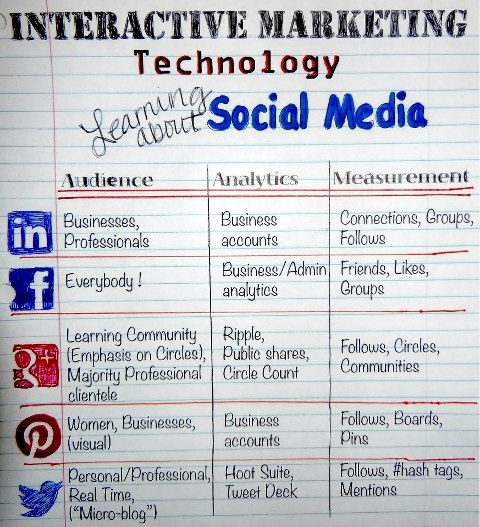
Sometimes students think because they are students they can't contribute.  They don't realize being in an Interactive Marketing program like ours gives them and advantage in terms of knowledge and understanding in the area.  But everyone has something to contribute online.  The students learned that they could take a blog post or something we had learned in class, put a twist on it or make a comment and create value for those reading the information.  Witness the graphical approach to taking notes in class above by +Felicia Aguillon.  Her summary of our last day of class on social media was well-received not just by me but other social media outlets where it was posted.

So this post shows you can develop your brand, connect and contribute on social media networks and in a short time change how you are perceived and create value online.  It only took a few weeks to change perceptions.  The students changed how they were perceived online and also how they were perceived by others.

By Debra Zahay-Blatz.
You can find Debra on and Twitter as well as LinkedIn.

Monday, April 29, 2013

Google Authorship Made Easy


Establishing Google Authorship Can Be Easy

This post summarizes how to create Google Authorship on your blog posts and other content.  There has been a lot of talk about Google Authorship and I have read some excellent posts about how to be credited in search results on Google.  I have shown an example above of how my blog shows up on Google when I am logged in to Gmail in the above screen shot.  I am shown with my picture, my name as shown on my G+ profile and the number of my G+ Circles.  This type of display is the goal. +Andy Crestodina  helped me establish this authorship in search   I followed the instructions that he presented at the January Chicago AMA Meet the Experts Night.  It took a few weeks but everything is showing up in search quite nicely now.  Even in my econsultancy.com blog authorship shows up after I followed these steps.

I think the key is to understand that there is a way to do this even if you are not blogging on a domain where you have an email on that same domain.  In my classes we use publicly available tools like WordPress or Blogger so we needed a way to link authorship without the verifiable email address.

Briefly, you need the following:
1) Put a nice head shot on your  G+ Profile
2) Use the same name on your profile as your byline, i.e.,  "By Debra Zahay-Blatz"
3) Copy and past HTML code into your blog that establishes the link.  Some code is on my slideshare presentation on this subject and on Andy's blog.

I also think it is important to set up your G+ profile properly with links to everything to which you contribute so these items can all show up in search as well.  Good luck establishing authorship and don't hesitate to contact me if you have any questions.  My slideshare presentation also shows how to link Google Analytics to your blog, which is extremely helpful in tracking activity and seeing information who you are reaching and how long they stay on the page.  

The slideshare also covers assessing your online presence, Filling out your Google+ Profile, Pursuisng Authorship and how to link your blog to Google Analytics.  The byline from the code is shown below.

By Debra Zahay-Blatz.
You can find Debra on and Twitter as well as LinkedIn.

Saturday, April 20, 2013

Scholarship Awards Ceremony Honors Interactive Marketing Students


At our Scholarship Awards Ceremony last Saturday, April 13, 2013 at Barsema Hall at Northern Illinois University, we honored a number of graduates in our Interactive Marketing program.  Recipients of the Interactive Marketing Board Awards were +Sarah Harant and +Nicole Gault (shown above with +Dave Henkel and +Debra Zahay-Blatz.   The Zahay-Blatz Family Award went to +Sekou Noriega.  Joe Glaser from Glaser Direct presented his award, targeted for those interested in B2B, to +Nick Kochetta.  The Johnson & Quin Award was presented by President +Dave Henkel to +Amanda Forneck, who will be beginning a full-time position at Johnson & Quin in the Fall.   Thanks to the generosity of our Corporate Advisory Board members for these Awards.

These awards were given for scholarship and dedication to the Interactive Marketing Field.  Look for these talented graduates to make substantive contributions to careers in Search (SEO and SEM), Social Media, Email, Website Usability and Testing and other areas that are a focus for our Interactive Marketing Program.

Interactive Marketing students also receiving scholarships were +Jason Conklin and Allison Greco, recipients of the Michael T. McSweeney Endowed Direct Marketing Scholarship. Interactive Marketing Student Board President +Mike Glassberg received both the Marketing Achievement Award sponsored by the Department of Marketing Faculty and the Top Marketing Achiever Award. Student board member +Antonio Garay received the Always be Contributing Award.

A highlight for me was the fact we honored +Dave Henkel as an honorary Alumnus of the Department of Marketing at Northern Illinois University   Dave's company, Johnson & Quin, has recruited on campus most years out of the last 20 and has hired closed to 30 people out of the IM program and it's predecessor program in Direct Marketing.  Dave said the association with NIU is a good fit because our students are hard-working and come in well prepared.  Program graduates don't have to be taught the basic vocabulary of the direct and interactive business because they have already learned in in their Marketing classes and Interactive Marketing classes in particular.  Dave has been a corporate board member for almost ten years and this award was well-deserved.  Thanks to Dave for his service to NIU and the IM program and congratulations to all on their awards.
By Debra Zahay-Blatz.
You can find Debra on and Twitter as well as LinkedIn.

Friday, March 15, 2013

Report from the "Hot Seat" at Chicago AMA


The @chicagoama 'hot seat' March 14 at Catalyst Ranch, sponsored by the AMA Higher Education SIG, was a lot of fun.  There was a great group of attendees from various aspects of the marketing profession and the 'Ranch' is a great venue for creative thinking.

Here are some key takeaways from the event:


1) Social Marketing on G+ is going to explode, the group (and I)  thought.  The increased visibility on searches and the ability to share and collaborate on other Google products and platforms like drive and email will allow G+ to explode. Martin McGovern from @idealemon said that G+ is a learning center and I got home and found that Google had just launched Think Insights for the digital marketer. I did take a quick look and it appears to be a learning center for Digital Marketing 

2) Content Marketing is going to 'make sense' of social media marketing.  Start with strategy:  what are your strengths and what content should you be creating?  Think about the content that goes with reinforcing your brand image.  This content then can be re-purposed on all forms of social media, thereby integrating messages across platforms (what we used to call IMC).

3) Content Marketing is well-suited to the University environment.  We professors are creators of content.  Once professors understand that by being well-known on the web through content they will be found more easily in searches, that will motivate them to create more online content.  Tell them about Author Rank.  Other incentives may have to be used to get them going and they may have to learn to write like a blogger, not like a professor.

We talked about a number of other things, including the redesign of the Facebook page to include ads in the news feed.  I said that we are publishing a paper on this subject in our Journal of Research in Interactive Marketing, on the fact that Facebook visitors don't tend to look at banner ads in the current format and why.  The Journal articles are designed to be read by both practitioners and academics so take a look and what we have published and see if it can help your marketing.

Thanks again for the great event, AMA Higher Education SIG, +Carrie Fuller, +Paul Stark and +Paula Kapacinskas and thanks to the lively and engaged attendees.

By Debra Zahay-Blatz.
You can find Debra on Google+ and Twitter as well as LinkedIn.

Saturday, February 9, 2013

Content Marketing Makes Sense of Social Media


I recently attended a webinar on content marketing hosted by +Tim Ash of SiteTuners and featuring +Joe Pulizzi.  Joe says marketers are not only publishers, but teachers and story-tellers as well.  The graphic above illustrates Joe’s concept that marketers are all story-tellers now and tell their stories across channels. Joe gave the example of one of the first content marketers as John Deere.  That company had a new concept, a steel-tipped plough versus iron and created its own company magazine, The Furrow, to get the word out.  That magazine now has 1.5 million subscribers in 14 languages.

Contemporary examples of those doing content marketing well include Red Bull, which has its own media house within the company.  Red Bull has a record label, its own video magazine and a content pool of sports, culture and lifestyle material that  that includes a full media catalog, “plug-and-play web clips, documentaries, news pieces, photo shoots, the latest interviews, and accompanying editorials.”  The content pool contains over 50,000 photos and 5,000 videos alone.  Also, The Coca-Cola Company has four full time writers and a team of forty freelancers devoted to content marketing and has documented its strategic plan for content marketing on YouTube as it moves from ‘creative excellent’ to ‘content excellence.”


This trend toward content marketing is not restricted to large consumer brands.  


Emarketer reports in a recent survey that content marketing is the top concern of client-side marketers for 2013, having tied conversion rate optimization and vaulted ahead of social media engagement.  Fully 39% of marketers surveyed indicated that content marketing was their top concern in 2013 and the Content Marketing Institute indicates that 91% of marketers are using content marketing in some form.

Content marketing to me finally makes sense of social media marketing.  Although social media marketing no doubt has some value, firms still wrestle with measurement, how to provide meaningful content, and how to get away from what I call “Groupon Syndrome,” or focusing on short-term promotion versus brand building and engagement.  Enter the concept of content marketing and now the marketer can focus on telling the brand story across channels; add the Integrated Marketing Communications concept of telling a consistent message across channels and it is no wonder marketers are starting to see the value of content marketing.

Content marketing means every brand is in the publishing business now, creating meaningful content to tell the brand’s story and engage the consumer.  Telling the brand’s story cuts across channels and involves not only social media but SEO, Lead Generation and other channels. The content we are talking about is media owned by the company, often times re purposed for many types of marketing communications.  Branding is more important now than ever as the web gives us access to so much information that products and services are in more danger than ever of becoming a commodity.

Part of my job as a professor of marketing is to help make sense of marketing trends and create meaningful frameworks to explain and describe them.  Although social media is fascinating and fun, social media marketing cannot operate in a vacuum.  Content marketing makes social media make sense as a natural vehicle for telling the story of the brand and allowing customers to engage with the brand.  Seeing social media in the context of content marketing, where the same stories are deployed through other media channels, to me legitimizes social media marketing and puts it in context of other media channels.  What do you think? 

 By Debra Zahay-Blatz.
You can find Debra on and Twitter as well as LinkedIn.