Showing posts with label social media. Show all posts

Saturday, May 3, 2014

Three Key Findings from Recent Research in Social Media Marketing

This spring at the +Marketing Management Association Conference March 26-28 at the Palmer House Hilton,  The conference featured several sessions on social media marketing.  Researchers looked at a social media networks and social media marketing's influence on brand equity, compared usage of social media sites by large brands and explored how particular brands appeal to their female customers on social media. This post explores the highlights from each presentation.


Attitude toward Social Networking Pages are Related to Brand Equity


The first presentation at the Friday 9:30 am session was titled, “Exploring the Impact of Social Networking Sites on Brand Equity.  The presentation was made  by researchers +Tiffany Machado Blanchflower and Kittchai Watchravesringkan from the University of North Carolina-Greensboro.  Not surprisingly, using the hierarchy of effects models and studying brand relationships across firms on Facebook, the researchers demonstrated that (just as attitude toward the brand influences brand equity) attitude toward the brand page in social media also influences brand equity.  The aspects of brand equity affected in particular are brand awareness, perceptions of quality and brand loyalty.

Customers on social media also like to be entertained which is also  related to a positive attitude toward both the social networking site and the brand page.  New forms of media can provide both information and entertainment. The positive consumer attitudes that result from this activity can have a long term effect on brand equity.  As indicated from the research, brand pages really help reinforce brand relationships but may not be the best place to build a brand relationship. In addition, while new forms of media can influence attitudes toward a brand and long term value, once brand equity is lost it can be difficult to maintain.


Social media marketing, brand equity.
Social Media' Marketing's Relationship to Brand Equity


Coke vs. Pepsi:  Who Wins on Social Media?


Another set of researchers, Ainswoth Bailey and Colleen Slattery from the University of Toledo, compared the usage of both Coke and Pepsi in terms of social media sites.  These are both high involvement brands that have younger consumers in their target market.  Baileyand Slattery found that Pepsi lags behind Coke in social media usage.

 A comparative analysis of Coke and Pepsi's social media usage as  part of its communications strategy showed Coke is doing a better job of engaging and getting customers to their social media sites.  Coca-Cola is brand people have rallied around.  The brand is more communal.  Pepsi might be another type of brand that is perhaps more disengaged.

For example, Coca-Cola reached out to consumers who started a brand page on Facebook and incorporated that page into their social media strategy, in a clear signal that the consumer is in charge of brand conversations.  Not only is Coca Cola known for its community of fans pushing messages, but Coke wants to have a strong content marketing strategy based on brand stories that are 'liquid and linked' together.  I teach in my social media class that Coca-Cola  wants to have stories that can be shared easily and that have a lasting impact.  The stories are liquid because they are constantly changing and linked because they are related to brand strategy.

This research showed that although Pepsi is supposed to be targeting the youth market, the firm is not using social media to its advantage in the beverage market.  For other products, such as Doritos, social media has been quite effective for the company.   Perhaps this result indicates just how strong the fan base must be to energize a social media campaign.  You can't force 'buzz.'


'Instamarketing' Toward Women and the Impulse Buy  


Another researcher, Areej Hassan from Minnesota State University-Mankato, studied  'instamarketing', comparing the usage of Instagram in marketing in brands targeted toward women up to 49 years of age such as  Zara, and  Forever, 21.  She analyzed persuasive messages in Instagram from brands targeted to younger women versus brand with a larger audience.  Messages in brands that targeted these women tended to be more emotional and persuasive than other brands.   The research found that companies that target women use a different social media approach than the general population.  These messages to women tend to target specific purchases, encouraging impulse purchases and also use celebrities in the images.  Women seem to want to engage more than men on social media and may be more prone to impulse buys.


What we can Take-Away


In summary, the key take-aways from these talks were:
1) Social media usage can enhance brand equity and build customer relationships but is not necessarily suited to building brand awareness.
2) Customers drive social media efforts, as evidenced by Coke vs. Pepsi.
3) In social media, women appear to respond to emotional appeals targeted at impulse purchases.

We have a lot of research to conduct in social media but these three presentations made an excellent start in helping practitioners understand what can be effective on these platforms.


By Debra Zahay-Blatz.
You can find Debra on  and Twitter as well as LinkedIn.

Monday, October 28, 2013

Don't Miss Out on These Social Networking Sites!

I am teaching social media marketing this semester at +Aurora University  and in my day class we have just finished talking about the major social media platforms, Facebook, Twitter, Google+, LinkedIn, Pinterest/Instagram.  We focused in the first half of class on using these platforms for social networking professionally and improving our personal brand image.  Other forms of professional social networking are often overlooked. I wanted to describe three social networking sties that are helpful professionally in this blog post.  The post will. focus on BuiltIn Chicago, Slideshare and Meetup.


Share Slides, Learn More

Each of these three social networking tools is designed to help people develop their particular interests. +SlideShare Inc provides is a social sharing site designed for sharing content in a user-friendly manner.  I use Slideshare.net to post presentations I have given so that i can get the word out about what I am doing to a broader audience.  I also use Slideshare when I want to find out about something new.  One of my friends said you can learn brain surgery from the site!  This statement is almost true, as there are presentations on nearly every subject posted.  Slideshare also suggests new presentations based on what I post, so I get a lot of recommendations for CRM and customer information management.

Follow Startups in Chicago, Find Jobs

BuiltIn Chicago is a local social sharing site that allows you to connect with people in your industry.  The focus is primarily on start-up and technology companies, so I get an opportunity to see what is happening in our area.  They also have live "launch" events periodically to foster in-person sharing.  The site also has an active job board and an emphasis on blogging.  In fact, I found several entry level jobs and internships on the site in our area of digital marketing.

Develop Your Interests, Network Locally

The final site I want to focus on in this post is Meetup.com.  Meetup is a great way to find people in a particular professional field but also has groups to help develop your professional interests.  I am a member of everything from bicycling groups to groups that focus on 'big data' technology.  I also am a member of the local American Marketing Association group.  Many people in Chicago use Meetup to connect. In fact, BuiltIn Chicago also posts events on Meetup.  Through email updates I learn what is going on with my groups.  I like the local focus as there are events in the Fox Valley I can attend and not just downtown Chicago.

I would strongly recommend adding these social networking tools to your 'toolkit,' whether you are a student, recent grad or have been working a long time.  If you are interested in learning more about a subject, networking with those in the area, finding a job or internship or just keeping up, you should try out these three websites:  Slideshare, Meetup and BuiltInChicago.

By Debra Zahay-Blatz.
You can find Debra on  and Twitter as well as LinkedIn.

Monday, August 26, 2013

Three Things You May Not Know About Social Media Marketing at Aurora University

Social Media Marketing Can Be Taught


First, you may not know that we teach Social Media Marketing at Aurora University.  The Social Media Marketing course I am teaching is new this semester.   I recently accepted a position as Full Professor of Marketing at AU and will be teaching in the Marketing Department.  Next Fall we are launching a new Digital Marketing Undergraduate Minor.  However, you can take Social Media Marketing as part of the current Undergraduate program in Interactive Marketing, earning either a minor or a concentration. 

I have been teaching Internet Marketing for almost fifteen years and many former students are working in social media. This area of marketing has strong employment potential, something I am always aware of when deciding what material to cover in class.  You can read more about my background and teaching philosophy and find how where to find me on social media here.


Social Media Marketing


Social Media Marketing Has Many Sides


Everyone reading this post may be familiar with and able to post to one of the major Social Media Platforms like LinkedIn and Twitter.  We are going to learn how to create a personal social media plan, including a LinkedIn profile that will get you noticed in searches.  In the course of this plan we will learn the major social media platforms and how to use them to get noticed by potential employers and others in the field.  Along the way we will learn about Google Authorship, effective blogging techniques and how to write for social media.

We will also learn the structure and discipline of a corporate social media plan and how it fits into a digital marketing strategy.  In every marketing discipline we need to learn how to plan, implement and measure our programs.  Social Media Marketing is no different.  As I have previously stated in this blog and on slideshare, I view social media as integral to content marketing.  In fact content marketing 'makes sense' of the seemingly disparate forms of social media depicted by the above graphic.

Your work products from this class will be both the Personal Social Media Plan as well as a corporate plan.  In addition, you will know how to build a presence on LinkedIn, Twitter, Facebook, Pinterest, Instagram, Google+ and YouTube.  The course has lots of lab time and is interactive and collaborative.  You won't be bored---I hope!

You Can Still Enroll


If what you read is interesting to you, there are still spots left in Social Media Marketing.  
BUS 4610 01 Social Media Marketing meets Tuesday & Thursday  1:15 pm to 2:30 pm, DH 102. I hope to see you there.  For those who can't fit the course into their schedule and for my corporate friends  follow the progress of the course in this blog.

By Debra Zahay-Blatz.
You can find Debra on  and Twitter as well as LinkedIn.

Saturday, July 13, 2013

How to Tell Your Story through Content Marketing and Still Have a Life

Content Marketing Makes Social Media make Sense

At my talk at Kishwaukee College yesterday I reiterated my theme from a prior blog post on content marketing that content marketing makes social media make sense.  I defined content marketing and content creation, explained the role of strategy in the process and then went on to give some examples of how to re-purpose content to get the kind of growth that we need.

What is Content Marketing?

Content marketing is a series of steps and processes as related to the media owned by a company, whereby that media is used to attract and retain customers.  We often speak of content 'curation,' which indicates that content is developed and managed 'by hand,' instead of spun by machines or just regurgitated in another format.  Content should be carefully prepared to reinforce the company 'story' or brand image.


Steps for Content Marketing

The process for good content marketing is as follows:
1) Start with a brand story.
2) Figure out meaningful message and associated content related to that story.
3) Dissseminate that content where your audience is likely to be so they can consume the content, react to it and co-create content.

Self-Knowledge is the Key

Understanding your company strategy and why you are creating the content is a useful exercise in content creation marketing, and, as I explained in a prior blog post, the first step in content marketing.  The company strategy can be translated into the story for the brand using the simple format for a positioning statement that I use in class.

The format is to the Target Customer, the Product Name is the Product Category that Point of Difference.  For example, Colgate's WISP product for brushing your teeth on the go might have used this format for the positioning statement.

"To the on-the-go college student or urban professional, ages 18 to 25, both male and female, WISP is the mini-disposable toothbrush that makes you Be More Kissable."  The company target is Generation Y and the idea is that if your teeth are fresh, no matter how busy you are,  you will be more attractive to the opposite sex.  This simple positioning statement then provided the brand story, which lead to an active social media campaign.  The company chose various forms of social media, including some clever YouTube videos, to convey its message because that is where its audience resides.

My Story as an Example

I gave the example that as a marketing professor I wanted to reach marketers who would view our program as a thought leader and potentially hire our students.  With that in mind, my social media journey really began with LinkedIn, since that is a social media site devoted to business leaders.  I now have over 2,000 connections on LinkedIn and am in the top 1% of those on the system.

At the same time I posted on LinkedIn, I also worked to increase my Twitter following, within a targeted group.  However, things did not really take off for me in terms of social media until I started posting meaningful content on a daily basis.  Like many professionals, I have a job other than creating content for social media (teaching, research, service), so I rely on disseminating the content of others as well.

I try to blog weekly and invariably the most comments I get are on the content I create myself.  So one strategy is to add value to re-posted content, not just send it out again in a different form, but really provide another aspect of the content and insight from what is written.  I pose a question or interpretation or comment when I re-post the comments of others, thereby making the content part of the stream of content people see on a regular basis.

I also make the most of my own content by thoughtful re-purposing.  For example, I recently gave a talk at Conversion Conference with Brian Massey on how direct marketing lessons can be used in website conversion.  We took that material and made a Slideshare with audio and then I referred to that material on my own blog, giving a recap of direct marketing principles as used for paid search.  I am also a guest blogger for Exact Target and I was able to create a blog post for them on the psychological background behind our talk, still linking back to that original blog post.

So now with the same talk as a basis, I created three different perspectives on the material, all of which contributed to a spike in pageviews for my blog.  When I started posting meaningful content five times a week, I went from 400 pageviews per month to almost 5,000.

Remember, your customer will respond to a good story and good content to tell that story.  If you want to see the slides from my talk on this subject, you can access the Slideshare above.  Let me know if you have any questions.

By Debra Zahay-Blatz.
You can find Debra on  and Twitter as well as LinkedIn.

Monday, May 6, 2013

Everything I Learned About Social Media I Learned from My Students


This post shows how you can develop your brand, connect and contribute on social media networks and in a short time change how you are perceived and create value online.  We just finished our social media module in Marketing Technology at Northern Illinois University   I gave them a basic structure to start building a personal social media plan using the top five platforms of LinkedIn, Facebook, Twitter, G+ and Pinterest.  There was no time to have them develop videos but we discussed the importance of YouTube and video in general in improving search engine results and web site engagement.

Teaching this class is like teaching in a Petri dish, a big sloppy experiment in various aspects of digital marketing.  I can observe the results of marketing campaigns that we deploy, see which PPC approaches work best and how online and offline strategies interact.  In this case, I made some simple suggestions for each of the five social media platforms and then sat back and watch the results come back.  I already noted in a prior blog post that making simple profile changes to LinkedIn resulted in more targeted job opportunities within twenty-four hours.

What I noticed was that my students were able to get results quite quickly from simple changes that they made to their approach to social media.   When we started the project, few of them had an organized approach to their personal social media plan.   I just finished reading their reflection papers on the subject and want to share some insights as to what worked for them and can work for you.

You can change how you are perceived online

Just by following my advice and fleshing out their Google+ profiles, when they were logged in to Gmail they could see a more professional appearance online.  Their LinkedIn, blogs and other online information showed up first in search results and helped them to present a more professional appearance.  This all happened in a few weeks time and many of them had online profile to begin with that reflected their personal rather that their professional lives.  Social media marketing helped them develop their personal brand image.

You can connect to just about anyone

The students were asked to connect to people where they might want to find a job or just find out more about the interactive marketing field  and this approach was effective.  Students were able to find people at key interactive companies and connect to them.  I recommended having some sort of relationship before connecting, i.e., having met them at a seminar or participated in a group discussion or webinar with them, before making the connection.  The students have the added advantage of being students.  Everyone loves to help students (I know I do).  I told them make these connections now while they are in the student role.

Everyone can contribute something online

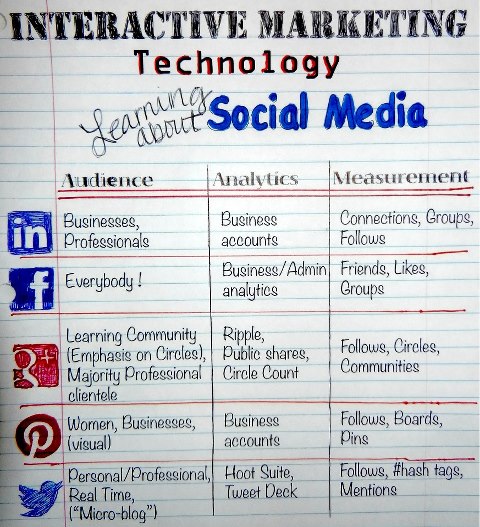
Sometimes students think because they are students they can't contribute.  They don't realize being in an Interactive Marketing program like ours gives them and advantage in terms of knowledge and understanding in the area.  But everyone has something to contribute online.  The students learned that they could take a blog post or something we had learned in class, put a twist on it or make a comment and create value for those reading the information.  Witness the graphical approach to taking notes in class above by +Felicia Aguillon.  Her summary of our last day of class on social media was well-received not just by me but other social media outlets where it was posted.

So this post shows you can develop your brand, connect and contribute on social media networks and in a short time change how you are perceived and create value online.  It only took a few weeks to change perceptions.  The students changed how they were perceived online and also how they were perceived by others.

By Debra Zahay-Blatz.
You can find Debra on and Twitter as well as LinkedIn.

Saturday, April 20, 2013

Scholarship Awards Ceremony Honors Interactive Marketing Students


At our Scholarship Awards Ceremony last Saturday, April 13, 2013 at Barsema Hall at Northern Illinois University, we honored a number of graduates in our Interactive Marketing program.  Recipients of the Interactive Marketing Board Awards were +Sarah Harant and +Nicole Gault (shown above with +Dave Henkel and +Debra Zahay-Blatz.   The Zahay-Blatz Family Award went to +Sekou Noriega.  Joe Glaser from Glaser Direct presented his award, targeted for those interested in B2B, to +Nick Kochetta.  The Johnson & Quin Award was presented by President +Dave Henkel to +Amanda Forneck, who will be beginning a full-time position at Johnson & Quin in the Fall.   Thanks to the generosity of our Corporate Advisory Board members for these Awards.

These awards were given for scholarship and dedication to the Interactive Marketing Field.  Look for these talented graduates to make substantive contributions to careers in Search (SEO and SEM), Social Media, Email, Website Usability and Testing and other areas that are a focus for our Interactive Marketing Program.

Interactive Marketing students also receiving scholarships were +Jason Conklin and Allison Greco, recipients of the Michael T. McSweeney Endowed Direct Marketing Scholarship. Interactive Marketing Student Board President +Mike Glassberg received both the Marketing Achievement Award sponsored by the Department of Marketing Faculty and the Top Marketing Achiever Award. Student board member +Antonio Garay received the Always be Contributing Award.

A highlight for me was the fact we honored +Dave Henkel as an honorary Alumnus of the Department of Marketing at Northern Illinois University   Dave's company, Johnson & Quin, has recruited on campus most years out of the last 20 and has hired closed to 30 people out of the IM program and it's predecessor program in Direct Marketing.  Dave said the association with NIU is a good fit because our students are hard-working and come in well prepared.  Program graduates don't have to be taught the basic vocabulary of the direct and interactive business because they have already learned in in their Marketing classes and Interactive Marketing classes in particular.  Dave has been a corporate board member for almost ten years and this award was well-deserved.  Thanks to Dave for his service to NIU and the IM program and congratulations to all on their awards.
By Debra Zahay-Blatz.
You can find Debra on and Twitter as well as LinkedIn.

Saturday, February 9, 2013

Content Marketing Makes Sense of Social Media


I recently attended a webinar on content marketing hosted by +Tim Ash of SiteTuners and featuring +Joe Pulizzi.  Joe says marketers are not only publishers, but teachers and story-tellers as well.  The graphic above illustrates Joe’s concept that marketers are all story-tellers now and tell their stories across channels. Joe gave the example of one of the first content marketers as John Deere.  That company had a new concept, a steel-tipped plough versus iron and created its own company magazine, The Furrow, to get the word out.  That magazine now has 1.5 million subscribers in 14 languages.

Contemporary examples of those doing content marketing well include Red Bull, which has its own media house within the company.  Red Bull has a record label, its own video magazine and a content pool of sports, culture and lifestyle material that  that includes a full media catalog, “plug-and-play web clips, documentaries, news pieces, photo shoots, the latest interviews, and accompanying editorials.”  The content pool contains over 50,000 photos and 5,000 videos alone.  Also, The Coca-Cola Company has four full time writers and a team of forty freelancers devoted to content marketing and has documented its strategic plan for content marketing on YouTube as it moves from ‘creative excellent’ to ‘content excellence.”


This trend toward content marketing is not restricted to large consumer brands.  


Emarketer reports in a recent survey that content marketing is the top concern of client-side marketers for 2013, having tied conversion rate optimization and vaulted ahead of social media engagement.  Fully 39% of marketers surveyed indicated that content marketing was their top concern in 2013 and the Content Marketing Institute indicates that 91% of marketers are using content marketing in some form.

Content marketing to me finally makes sense of social media marketing.  Although social media marketing no doubt has some value, firms still wrestle with measurement, how to provide meaningful content, and how to get away from what I call “Groupon Syndrome,” or focusing on short-term promotion versus brand building and engagement.  Enter the concept of content marketing and now the marketer can focus on telling the brand story across channels; add the Integrated Marketing Communications concept of telling a consistent message across channels and it is no wonder marketers are starting to see the value of content marketing.

Content marketing means every brand is in the publishing business now, creating meaningful content to tell the brand’s story and engage the consumer.  Telling the brand’s story cuts across channels and involves not only social media but SEO, Lead Generation and other channels. The content we are talking about is media owned by the company, often times re purposed for many types of marketing communications.  Branding is more important now than ever as the web gives us access to so much information that products and services are in more danger than ever of becoming a commodity.

Part of my job as a professor of marketing is to help make sense of marketing trends and create meaningful frameworks to explain and describe them.  Although social media is fascinating and fun, social media marketing cannot operate in a vacuum.  Content marketing makes social media make sense as a natural vehicle for telling the story of the brand and allowing customers to engage with the brand.  Seeing social media in the context of content marketing, where the same stories are deployed through other media channels, to me legitimizes social media marketing and puts it in context of other media channels.  What do you think? 

 By Debra Zahay-Blatz.
You can find Debra on and Twitter as well as LinkedIn.

Friday, October 26, 2012

Students create search/social campaigns for real clients


This semester my students in Marketing 470 are creating search and social media campaigns to help one not-for-profit (the NIU Marketing Department) and two for profit firms, Allworld Machinery Supply (a top machine tool supply firm)  in Harvard, IL and Ideosity, Inc. (a boutique web developer) based in Elgin, IL drive traffic to their site through PPC and social media campaigns.

The students work with the firm as consultants to develop the paid search strategy and then are given a budget and three weeks to implement their campaign (five for social media) for the three clients.   Both Allworld and Ideosity have NIU grads in key marketing positions.  Tim Yapp is one of the key contacts on the project for Allworld and Kalli Bravos is heading up the project for Ideosity.  Each former student is applying what they learned about search, social media, other interactive principles and general marketing knowledge on the job.  Both Rich Dase, one of the Founders and President of Ideosity, Inc. and Dave Koepp, the President of Allworld Machinery, are also intimately involved in the process.

The company presented to the students in September and the students just presented their plans for approval on October 18.  All the plans represented that the students have a deep understanding of Interactive Marketing.  I was impressed by their knowledge of the interplay between web design and search engine optimization.  The students were also able to apply their knowledge of the keyword bidding process in Google Adwords and keep in mind the companies' strategy and overall marketing objectives.  Results will be measured using Google Analytics and other key marketing metrics.

Of course, these hands-on courses are not new to the Department of Marketing or to its students.  In our Interactive Marketing courses we have done similar projects and in every course give the students a real-life learning experience. By helping students to plan, implement and measure the results of search and social media marketing campaigns, NIU gives the students a real-life learning experience that they can take on the job market and show that NIU really is "Where the Classroom Meets the Business World."

Read more about the project in the Ideosity, Inc. press release and more about our program at our web site.


Monday, September 17, 2012

Internet Marketing Impacts B2B


One of the most important and misunderstood areas of interactive marketing is the broad area of business-to-business Internet Marketing.  For example, Oracle estimates B2B ecommerce revenue is about one and a half times as large as business-to-consumer (B2C) revenue.  Yet the submissions to the journal I edit, The Journal of Research in Interactive Marketing are primarily studies involving business-to-consumer (B2C) issues.  It appears from what is being published in other journals that the situation is the same.  Practitioner sources are of ten the same, emphasizing B2C examples.

The B2B sales area is positioned to be transformed by Internet marketing in at least the following four areas, all of which would be candidates for further examination by both practitioners and academics:

      1) The search process.  Business customers, like most customers, are relying heavily on the internet when   making purchase decisions.  Business customers conduct searches, visit industry social media sites and blogs (increasingly on mobile applications), talk to their colleagues and have a lot of information at their fingertips when the salesperson arrives at the door.  I have tried to illustrate what is happening in the graphic above, which shows all the places the B2B customer can collect information before the salesperson arrives.  In fact, I have seen estimates that the salesperson might now be only involved in two percent of the sales process.  Certainly it is time to explore how we might redefine the B2B search process and to consider extending the concept of the buying center to beyond the limits of the firm.

      2) The role of the salesperson.  This trend toward collecting more and more information before the salesperson arrives diminishes the critical role of the salesperson as the provider of information but potentially increases his/her role as consultative advisor and service provider.  However, lead nurturing systems such as those provided by Marketo now make automated decisions and hand the lead off to the salesperson at the exact right moment to close the sale http://www.xconomy.com/san-francisco/2011/11/08/death-of-the-salesman-marketo-is-automating-sales-relationships-and-growing-like-crazy/
The relative effectiveness of these automated and their impact on salesforce size and structure are issues that need to be discussed in industry.

3) The role of content marketing.  The role of content marketing is another under-researched area of business-to-business internet marketing.  B2B marketers tend to rely on presentation and downloading of content for nurturing relationships.  The suggestion is that effectively placed content on a web site can lead the prospect through the sales process, educating and answering questions along the way.  However, many questions need to be answered about content marketing, including what types of content are most effective in each stage of the customer lifecycle.  For example, the relative effectiveness of webinars versus whitepapers and which content is most effective in what context.

4) The role of social media.  Business-to-business marketers are successfully using social media but the role of these new media is also largely unexplored in academic research.  We know intuitively and from practitioner studies that Linkedin and Twitter are more likely to be useful in B2B contexts than Facebook but we need to understand why and in what context each type of social media marketing tool should be used.  What companies like IBM are doing with internal social networks could also be productive areas of study and replication.

I want to close by noting again that there are also a lot of opportunities for growth and research in the area of B2B internet and interactive Marketing and ecommerce beyond what we have time to mention here. 

Reference:
Oracle White Paper (2012), 2012 B2B E-Commerce Survey:  Results and Trends.

By Debra Zahay-Blatz.
You can find Debra on Google+ and Twitter as well as LinkedIn.

Monday, June 4, 2012

Multichannel Attribution


I love this graphic from Joel Book, ExactTarget's Education Chief because it illustrates how the topic of multi-channel attribution often seems to me like the search for the Holy Grail (the Last Cup of Christ).  The result can be elusive. Given the proliferation of channels, the complexity of the issue, cross-firm differences in resource allocation and other aspects of implementation, is there likely to be a broad-based answer to the questions of how to 1) attribute marketing results to marketing actions and 2) develop marketing programs that maximize spending? 

The four ways that I see academics are addressing and can further address these issues are as follows:

  • By investigating an industry:  In the Journal of Direct, Data and Digital Marketing Practice, Schultz, Block and Ramn have studied consumer media usage in three product categories, computers, automobiles and fast-food restaurants. (Schultz, et. al. 2009). In these studies as in other marketing studies elsewhere, we often see that where the marketer is spending their dollars (mass advertising) and where the customer is spending their time (social media) do not match.
  •  By examining a company:   Recently in  the Journal of Marketing (May 2012), Avery, Steenburgh, Deighton and Caravella investigated data from a high-end retailer to see if introducing a retail store in specific areas would affect catalogue and online sales.
  • By analyzing the customer:  Venkatasen and Kumar (2005) and Venkatasen, Kumar and Ravishanker (2007)  have developed a number of models from the point of view of the customer to explain and predict the adoption of multiple channels and discuss financial implications. 
  • By analyzing multiple firms (strategy):  Neil Morgan in a recent issue of JAMS (2012) outlined a conceptual framework to link all the different elements of marketing strategy and business performance, including implementation, which is often overlooked in research but critical in practice.

Although these efforts are great first steps toward answering marketing attribution questions, none of them really provide guidance as to how to attribute the results of marketing spending on brand advertising, social media, search etc. to performance.  The type of research conducted to date is a good start, but usually does not focus on the complexities facing the marketer today in a generalizable way and certainly does not look at cross-firm differences and performance.  So we as academics have an opportunity not only to apply rigor to these issues but to work on topics of real relevance to marketers today.

And the question of how to measure performance in this context is interesting also.  Should we look at ROI, or event CLV, as practitioners do, in hard numbers way?  Wouldn’t customer equity ala Rust and Lemon and Zeithaml (2004) be more appropriate or at least a metric that should be evaluated in conjunction with other measures (Stahl, Heitman, Lehmann and Neslin 2012).

Monday, April 30, 2012

"The Latest Wave" Internet Conference a Success


Approximately 130 marketing professionals participated in "The Latest Wave" in Internet Marketing at NIU's Naperville Center on April 19. Included in the group were about thirty students from the Interactive Marketing Program, most of whom will be graduating in several weeks with our certificate in Interactive Marketing or another specialization that prepares them for a career in search, data analytics, social, etc. Check out our interactive marketing program and see how you can benefit by hiring students and interns.

The Opening Plenary Session featured keynote speaker Ron Jacobs, President, Jacobs & Clevenger and Co-Author of Successful Direct Marketing Methods. Ron shared his insights on measurement and the merging of digital and Interacitve. Ron claimed that marketers are drowning in data and that in fact:

  • 1 in 3 marketers make decisions without critical information
  • 1 in 2 marketers don't  have the information they need to perform their job
  • Knowledge workers spend 19 hours each week searching for information
Ron went on to talk about the benefits and weaknesses of Key Performance indicators and how to measure some of the newer media channels such as social and mobile.

The conference had a special track on social media and a general track with a B2B emphasis and topics such as search, analytics and mobile. We featured speakers from Dell, CDW, Walgreens and other leading Interactive Marketing practitioners. The conference web site is here for more information on The Latest Wave in Internet Marketing 2012.  Check out what happened by monitoring the Twitter feed at #niuinetconf.  There are some good comments and questions on that feed.

Over lunch, there were networking tables set up on various topics and facilitated by our board members. The picture above shows our students taking advantage of the networking opportunity provided by topics such as how to make the transition from school to work during the first year or how to successfully navigate through agency life.

Also over lunch, attendees could choose from a variety of hands-on workshops demonstrating the basics in Twitter, Facebook, Google+ and HTML. The best part is that these sessions were taught mostly by our current students, Jenny Yam, Tyler Miller and David Delaplane. Everyone seemed to get something out of the event and it was a successful day. I am sorry for those who could not attend.

Saturday, February 4, 2012

Social Media from the Trenches


We are using a lot more social media marketing to promote our Internet Marketing Conference this year on April 19 at NIU Naperville. Social media helped us get the word out last year but this year we have subscribed to Hootsuite and are able to sent the same information out to multiple locations, including all the groups I am a member of in linked in (without posting to each separately and are able to schedule posts in advance).

We have created a fan page in Facebook for our IM program and created an event under that page an also have a Linkedin event and a separate Twitter account for the event. Heather Baker, Contract Recruiter, and my grad assistant Alex Eddy have been helping us out, with guidance from board member Jen Brady, President and CEO of Fred and Associates.

We are also using direct communications and have 23 registered from an initial email sent out from me personally to past attendees and board members, so we are well on our way to our goal of 100 attendees. (Twenty six of our students will attend also as guests of our program to enhance their personal learning).

One person from social media (Linkedin) has said they will register and one firm from Facebook said they were interested in sponsoring. So while for an event like this there is no substitute for a personal, direct appeal I expect a lot of interest from social media. We are expecting that our partners econsultancy.com, PMA, CIMA, the BMA and CADM will also promote on social media.

We are using our own internal social media network, Vivastream, to promote interaction among the conference speakers and attendees.

We are just getting started. I tend to look at social media as a bit more like advertising and PR than direct marketing, so the consequences cannot always be measured. I will keep monitoring and keep you updated.

Thursday, October 6, 2011

NIU IM Student learns about social media firsthand

Tyler Miller, an Interactive Marketing senior student reports on his social media internship and says , "Over the summer I interned at an experiential marketing agency in downtown Chicago, Legacy Marketing Partners. They are currently on Event Marketer Magazine’s “Top 100 Agencies”. While there, I worked alongside their social media guru and aided her in developing projects for clients.

My work consisted partly of online research into what trends were and who the top influencers were on social media for particular interests and industries. The clients I worked on projects for were all major national and multi-national brands, ranging from alcohol brands to appliance brands to quick service restaurants. During my time there I helped develop ideas for how social media could be used to enhance real world events, as well as programs that would take place entirely online. I was afforded the opportunity to help with projects for current clients and for potential business.

I learned a lot about all the work that goes into a social media campaign and how social media campaigns tie in with those in other channels. I was well prepared for this experience through my classes at NIU where we had already had some exposure to social media marketing and had worked with a social media tool. However, in my internship I also learned a lot that can't be taught in the classroom, such as the dynamics of an agency, how agencies run, how they work with clients, and how they often work with other agencies."

Wednesday, February 23, 2011

Alterian's SM2 hits the NIU campus!

This past week and a half we have had Alterian in our classroom twice in Marketing Technology to learn about how to analyze social media data. We learned some general background on social media and then learned the SM2 tool for use in the class project. What I learned is that it is important to look at not only frequency of mention as well as sentiment. Those companies that were ranked highest in mentions for the Super Bowl were not necessarily those that ranked highest in terms of sentiment.

Using SM2 I also realized how much of an art as well as a science these tools are. Looking through the social media postings for a particular topic I got a good feeling for the company I was researching in terms of their major competitors and how people think about the brand. As a quantitative researcher I was worried about how representative the sample was and how to really quantify some of this 'squishy' data. Still, SM2 is helpful in understanding how people think about your brand and we have emphasized the importance of technology for brand building in our class.

Is social media monitoring 'squishy' or valuable?

Tuesday, October 12, 2010

Amy Obert uses her IM skills at Dex One!

Amy Obert reports that she works for Dex One and the says the company focus is to simplify the complex task of local search marketing for businesses. Dex One publishes the AT&T Yellow Pages and offers businesses advice and internet SEM/SEO solutions, direct mail, websites, and mobile solutions as well, both B2B and B2C.

Amy focuses on working with firms as a marketing consultant to their business. By learning about the business and its focus, their customers, their needs, and most importantly the volume they can handle over the coming year, she builds them a message and program that best fits their business needs, including websites, profiles, and print.

Amy says "Dex One is able to track activity on almost all key areas of their advertising solutions so we know where people are looking most frequently for the business. Based on budget and growth needs, we place the customers message accurately and try to ensure their ROI will be a positive.

I am regularly looking at what works best in the market, staying up to date on building brand recognition, awareness, and where people are searching locally. Facebook, twitter, & YouTube, are great ways for small business to network and promote themselves and improve their customer touch points. (without extending a large amount of time) Plus, these tools extend the reach of their paid advertising programs. "

Amy provided a link that tells more about Dex: http://www.dexknows.com/info/index.asp
and says that the firm offers business seminars to help in learning good ways to stay ahead of competitors. http://kmcontent.quris.com/dex/?xL4V.HPc.HXrNUUfqkoEYLoM0s70Rho2x

Thanks Amy for all the good info. Glad to see you are doing so well.

Thursday, July 1, 2010

IM grad takes social media intership at Tilbury Corp via Linkedin!

Katrina Jefferson from my Interactive Marketing class of May 2009 writes, "This is Katrina Jefferson. I would like to take the time to personally thank you for the job posting for Tilbury Corp. After communicating with Tilbury via Linkedin, I was scheduled for an interview to discuss the position and later was offered an internship! I am excited to learn more about social media in this internship position and expect to make the most of this great opportunity!"

Wednesday, June 23, 2010

NIU IM Grad uses PPC, social media skills on the job

Eric Castellucci, who graduated in Spring 09', writes, "I have been doing Online Marketing for a company called Wrigleyville Sports; we sell merchandise for all the Chicago Sports teams. The job dabbles in everything from PPC, to Blogging, to Social Media. Pretty much, any online channel that has the potential to bring in sales. Much of what I learned in the IM Program at NIU helped me get this job, especially PPC.

Wrigleyville Sports was previously outsourcing their PPC to a third party in California, but they were not pleased with the results they were receiving. When they discovered I had experience with PPC through school, they hired me on full time. It has been a good match for both of us.

From what I've seen in the IM industry, the knowledge IM Graudates possess is GOLD to companies. I believe that at this moment, the demand for individuals with an IM background is much greater than the supply of knowledgeable graduates. Plenty of companies are learning the immense value from Social Media, and they are more willing to hire someone straight out of college who uses these Social Media tools on a daily basis."

Monday, June 1, 2009

Multichannel Marketing Class May 27th: Social Media

We had a great introduction to social media from expert Dana VanDen Heuvel. Dana spoke of the crisis in mass marketing as people lose trust in mass advertising and are interested in blocking advertising. He also said that advertising impact is difficult to measure but the same could be said for social media at this stage of the game. Nonetheless, the internet and digital marketing has put the customer in charge and marketers need to monitor what is going on with blogs, social networking sites, customer reviews and the like. Dana said some companies are now using these types of digital media to supplement or even replace traditional marketing research, although I think marketing research will always have a role to play. The problem with monitoring what is being said on the web is that a marketer can't know the demographics of those that are participating and only one percent of those on the web contribute to blogs, reviews, etc. The results of only monitoring web buzz can be biased.

However, there are great benefits and marketers cannot ignore what is going on in blogs and social media. Comcast Cable has a mechanism to track what is going on in Twitter for example and to respond to and fix customer problems before things get out of hand (they responded after a famous YouTube video in which a technician was photographed having fallen asleep waiting for his own company to respond to a customer service call).

The bottom line is that marketers can't afford to ignore these new forms of media. Dana also emphasized the importance of collecting and analyzing data regarding conversations about a particular brand on the web and about particular customers. We talked about using data contextually in advertising to deliver more relevant messages so the material was a nice tie-in to what we will be discussing this week: Creating databases to implement multichannel campaigns and to analyzes the responses.